
August 5, 2026 •Omnichannel Consulting
By David Wingate, Founder, OmniChannel Consulting
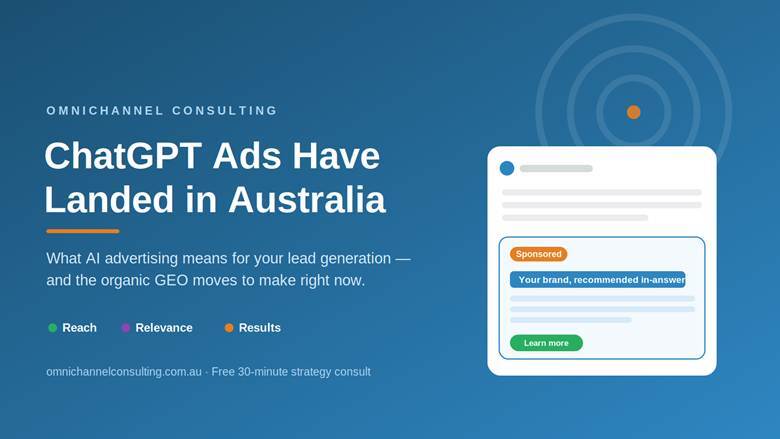
Your customers have quietly changed how they search. Instead of typing three keywords into Google and scanning ten blue links, millions of Australians now ask ChatGPT a full question and read a single, composed answer. That shift matters for every business owner who relies on being found. And in 2026 it took on a commercial edge: ChatGPT started carrying ads, and the rollout has reached Australia.
This is not a reason to panic or to tear up your current plan. It is a new channel to understand, position for, and use well. Here is a practical, no-hype guide to what ChatGPT ads are, where they fit in an omnichannel strategy, and the free organic moves you can make today so your brand shows up in AI answers whether you pay or not.
What are ChatGPT ads, exactly?
ChatGPT ads are sponsored placements that appear inside a ChatGPT conversation, shown beneath the assistant's answer in a clearly labelled, visually separated card. They are matched to the context of the conversation, not to a list of keywords you bid on, and, importantly, they sit alongside the organic answer rather than changing it. OpenAI has been clear that ads do not alter the substance of the response a user receives.
Two formats are emerging: sponsored results inside ChatGPT's search experience, and conversational placements woven into relevant chat threads. Ads currently show to users on the free tiers; paying Plus, Team and Enterprise users remain ad-free for now.
Are ChatGPT ads available in Australia yet?
Yes. After launching to United States users in early 2026, OpenAI named Australia as one of its first international markets, alongside New Zealand and Canada. Local usage had roughly doubled in the prior year and OpenAI stood up an Australian team, which is why we were near the front of the queue.
Access is through a self-serve Ads Manager with familiar buying models: cost-per-click and cost-per-impression bidding, and the early high minimum spends have fallen away, which opens the door to small and mid-sized businesses, not just enterprise budgets. As with any new ad platform, the specifics are moving quickly, so treat published figures as a snapshot rather than gospel.
How are ChatGPT ads different from Google and Meta ads?
Three differences matter for how you plan.
- Intent is expressed in full sentences. People tell ChatGPT what they are actually trying to do, often in paragraphs. That is richer intent than a two-word Google query, and it rewards advertisers who understand the customer's real problem.
- Targeting is contextual, not built on cross-site tracking. Matching happens on the live conversation inside OpenAI's systems; your personal browsing history is not handed to advertisers. Creative relevance beats audience list-building.
- The audience skews young and high-frequency. A large share of ChatGPT conversations come from users under 30. If that is your customer, this is prime real estate. If it is not, weight your spend accordingly.
The takeaway: ChatGPT ads are not a Google replacement. They are a new surface that behaves more like being recommended by a trusted adviser than like buying a banner.
Where do ChatGPT ads fit in an omnichannel strategy?
This is the question we care about most at OmniChannel Consulting, because a channel in isolation rarely pays back. Think of ChatGPT ads as an extension of the three plays you already run:
-
an extension of SEO, because the same authority that earns you Google rankings helps AI models trust and surface your brand;
-
an extension of paid search, because you are again paying to appear at a moment of high intent;
-
an extension of paid social, because the creative and the offer still have to earn attention.
Remember that only about 5% of buyers are ready to purchase at any moment; the other 95% are in a nurture stage. ChatGPT is increasingly where that 95% do their early research, comparing options and forming a shortlist long before they fill in a form. Showing up there, paid or organic, plants your brand in the consideration set. That is omnichannel shopper behaviour in action: the right message, to the right customer, at the right point in their journey.
Should you pay for ads, or optimise organically first?
Both, in the right order. Before you spend a dollar, you want to be the kind of brand an AI is willing to recommend for free. That discipline is called Generative Engine Optimisation, or GEO: the practice of getting your business cited inside AI-generated answers. It is the natural next chapter of SEO.
The difference in a sentence: SEO ranks your page; GEO gets your brand named in the answer. SEO is largely a first-party game on your own website. GEO is more of a third-party game, won across the wider web where AI models gather their evidence.
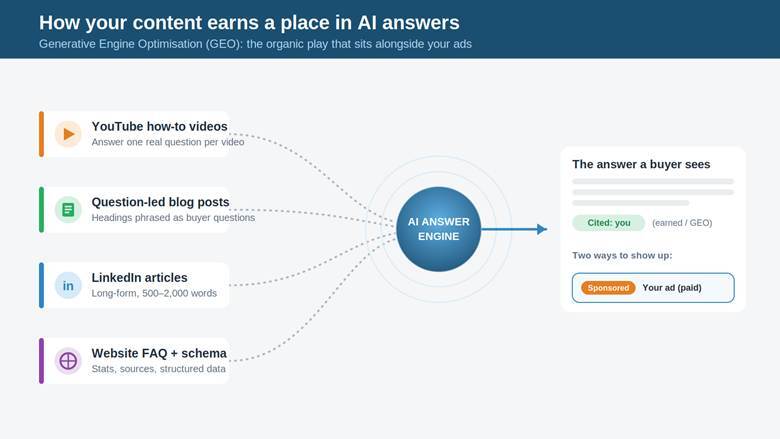
Many organic content sources feed the AI answer engine. Strong GEO earns you a cited place before you ever pay for a sponsored one.
What are the free GEO moves I can make this week?
You do not need a big budget to start. Five moves, all of which compound:
- Publish question-led blog posts. Phrase your headings as the exact questions buyers ask ("How much does X cost in Australia?") and answer them in the first two sentences underneath. AI models lift clean, self-contained answers.
- Post long-form LinkedIn articles. Long-form LinkedIn articles, not just short feed posts, are among the most-cited B2B sources in AI answers. Aim for 500 to 2,000 words on a topic you genuinely own.
- Make short YouTube how-to videos. One real question per video, spoken clearly, with a full description. Video widens the number of places an AI can find you saying the same thing, which builds its confidence to recommend you.
- Add proof and structure to your website. Include statistics, name your sources, add author bios and dates, and use FAQ and Article schema. Research on AI citations shows that adding statistics and citations meaningfully lifts how often content is surfaced.
- Help the machines find you. Submit your sitemap to Bing Webmaster Tools (ChatGPT's web browsing leans on Bing's index) and consider an llms.txt file that points AI crawlers at your best content.
Do these consistently and you build the authority that makes both your organic presence and your paid ads work harder.
What is the reach multiplier most brands miss?
Tagging and resharing. On LinkedIn especially, the fastest way to extend reach is to bring other people into your content and to add value to theirs.
- Tag with purpose. When you genuinely reference a person, partner or brand, tag them. It notifies them and opens your post to their network. The rule is relevance, not spam; tag people who are actually in the story.
- Reshare with a point of view. Do not just hit repost. Add two or three sentences of genuine insight when you share someone else's post. That commentary is what the algorithm rewards and what makes people follow you.
- Turn your team into distribution. When colleagues and partners reshare your article, you win reach no ad spend can buy. This is employee advocacy, and it is one of the most underused levers in B2B.
Every one of those signals, comments, reshares, and tagged mentions, also strengthens the web of references that AI models read when they decide who to cite. Reach and GEO reinforce each other.
Where does OmniChannel Consulting fit?
This is exactly what we do. With more than 25 years across major FMCG brands and five years running digital and HubSpot for a fast-growth businesses, we help Australian businesses connect the dots between SEO, paid search, paid social, and now AI-driven discovery, into one omnichannel engine that generates leads.
We start with an AUDIT of your digital footprint, LEVERAGE your data and content assets, and OPTIMISE the whole customer journey so the right customer meets the right message at the right time. ChatGPT ads and GEO are simply the newest instruments in that orchestra.
Ready to turn AI discovery into leads?
If you want a clear, jargon-free view of where ChatGPT ads and GEO could fit your business, let us talk it through.
Book a free 30-minute strategy consultation: davidw@omnichannelconsulting.com.au
Connect with me directly on LinkedIn: https://www.linkedin.com/in/david-wingate/
This article reflects the state of ChatGPT advertising in Australia as at August 2026. AI ad platforms are evolving quickly; chat with us the the latest current guidance.